Agentic AI Governance: 5 Controls Enterprises Need for Safe Automation

The promise of agentic AI is dead simple to understand.
Instead of waiting for a human to draft every instruction, an AI agent can interpret a goal, take action, and work across systems until the task is done. For IT teams, that motion sounds like the next logical phase of automation.
That promise is real... but it’s also where the risk starts.
Traditional automation followed instructions. Agentic AI, by contrast, pursues outcomes. That difference turns the entire governance model on its head.
A scripted workflow can only do what someone designed it to do, but an AI agent has more room to decide what should happen next (especially when it has access to systems, data, credentials, and workflow tools). The better the agent gets at acting independently, the more important it becomes to define where that independence starts and stops.
Agentic AI governance is the set of policies, permissions, controls, oversight processes, and audit mechanisms that define how AI agents can make decisions and take action across enterprise systems. It helps teams control autonomy, manage risk, preserve accountability, and scale AI automation safely.
Without this proverbial north star, intelligent automation becomes difficult to trust at scale. But never fear; these are the 5 pillars that make AI governance and oversight work.
Key Takeaways
- Agentic AI governance defines what AI agents can access, decide, and execute.
- Governance should be built into workflows, not kept only in policy documents.
- Human oversight should be reserved for high-risk, unclear, or consequential actions.
- Context quality, action controls, and auditability are essential for trusted AI automation.
- The goal is to make autonomy conditional, visible, and controlled.
Pillar 1: Define Clear Boundaries for Agentic Autonomy
The first pillar of agentic AI governance is deciding what an agent is allowed to do.
That sounds obvious, but it’s worth mentioning because this is often where governance first breaks down. Teams get excited by what an AI agent can accomplish and start expanding access before they have defined the limits. The agent gets connected to more sources of context, and before too long, it can act across enough of the environment that no one has a clean answer to a basic question: where does its authority stop?
A service desk agent, for example, may be able to answer questions, reset passwords, update ticket fields, check device status, trigger approved workflows, and gather diagnostic context. That does not mean it should be able to make unrestricted access changes, alter production infrastructure, or close high-priority incidents without review.
Good governance gives the agent enough room to be useful without giving it authority it does not need. It’s just that simple.
What This Looks Like in Practice
- Define the agent’s role before expanding access.
- List approved systems and workflows.
- Separate low-risk, reversible actions from high-risk actions.
- Require approval for privileged access, production changes, or irreversible decisions.
- Review autonomy limits as the agent proves reliable.
The more clearly autonomy is defined, the easier it becomes to scale.
Pillar 2: Govern the Context the Agent Can Trust
This element matters because AI agents make decisions based on context. They interpret a request, pull information from connected systems, compare signals, and decide what should happen next. If the context is incomplete, stale, contradictory, or pulled from the wrong place, the agent can take the wrong action while still appearing to behave correctly.
That creates a different kind of risk than traditional automation, and here’s why: a scripted workflow usually fails when the input is wrong or missing. An AI agent may try to keep going. It may infer what the user meant, choose the most likely path, or act based on the available information. Sometimes, that’s incredibly useful, but other times, it’s exactly the problem.
Governance must define which sources of context are authoritative, what data the agent can access, when it should ask for clarification, and when missing context should trigger escalation. This is especially important in IT environments where the same user, asset, incident, or service may appear across multiple systems (albeit with slightly different information).
An agent that can see more is not automatically better governed. The important question that operators must ask here is whether it can distinguish reliable context from noise.
What This Looks Like in Practice
- Map the data sources the agent is allowed to use.
- Define which systems are authoritative for users, assets, permissions, incidents, and services.
- Limit the agent’s access to context that is relevant to its role.
- Create rules for handling missing, stale, or conflicting information.
- Require the agent to ask for clarification or escalate when it cannot verify the context needed to act safely.
- Review context sources regularly as systems, workflows, and ownership models change.
Pillar 3: Add Human Oversight for High-Risk Decisions
Human oversight often gets misunderstood as manual review for every meaningful action.
Humans should be involved when judgment, risk, or accountability requires them. An agent can gather context, diagnose an issue, and then provide a recommendation, but a human should step in when the action carries enough consequence to justify review.
This dynamic changes the role of the operator quite a bit. Instead of manually working through every task, the human becomes the overseer of exceptions and higher-risk decisions. They approve sensitive actions, review unclear cases, correct the agent when needed, and improve the governance model over time.
The best governance models are not built around constant supervision. Rather, they are built around judgment-aware automation.
What This Looks Like in Practice
- Define the specific conditions that require human review.
- Use escalation triggers such as low confidence, privileged access, production impact, missing context, conflicting signals, or unusual user behavior.
- Let the agent handle low-risk, repeatable work without unnecessary approval steps.
- Route high-risk or ambiguous decisions to the right human owner.
- Give reviewers enough context to understand what the agent found, recommended, and attempted.
- Use human feedback to improve policies, playbooks, and future agent behavior.
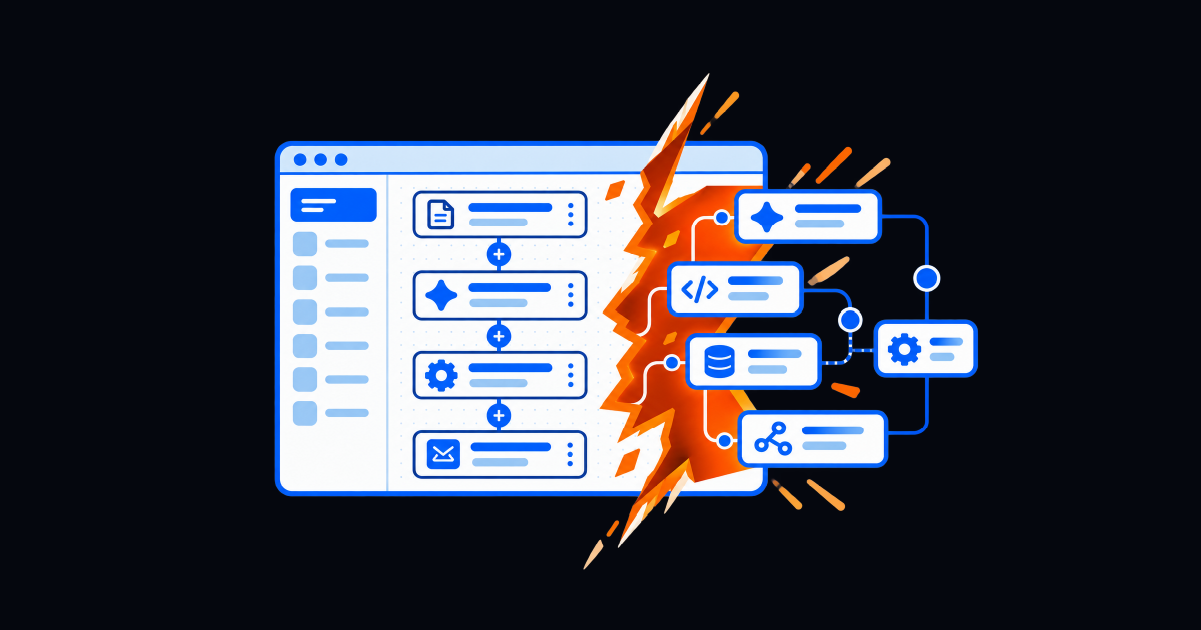
Pillar 4: Build Agentic AI Governance Controls Inside Deterministic Workflows
Governance cannot live only in policy documents. If it does, that’s where it suffocates. If an agent is operating inside workflows, then governance has to operate there too.
This is especially important because agentic AI can move quickly across systems. A single request might involve an ITSM platform, identity provider, endpoint tool, infrastructure system, collaboration channel, and monitoring platform. If the controls are outside the workflow, the agent may move faster than the organization can supervise.
Action controls turn governance into something the agent can follow in real time. These controls define which actions can be executed automatically, which require approval, which should only be recommended, and which are not permitted. They also define what happens when the agent reaches the edge of its authority.
This balance is what keeps agentic AI from becoming either too constrained or too loose. Without action controls, teams tend to choose between two bad options: restrict the agent so heavily that it cannot do meaningful work or give it broad access and hope nothing goes wrong.
A governed workflow gives the agent a better path. It can move quickly where the risk is low and pause where the risk is high.
What This Looks Like in Practice
- Classify agent actions by risk level and operational impact.
- Allow low-risk, reversible actions to run automatically.
- Require approval for sensitive, privileged, production-impacting, or irreversible actions.
- Build permission checks directly into the workflow before the agent takes action.
- Add rollback logic for actions that can be safely reversed.
- Define what the agent should do when it reaches the edge of its authority: pause, recommend, escalate, or stop.
- Review action logs to identify where controls are too restrictive or too loose.
Pillar 5: Use Observability & Audit Trails to Improve AI Agent Governance
At the end of the day, agentic AI governance depends on visibility. Teams need to know what the agent did, why it did it, which systems were involved, and what happened afterward.
This matters for compliance, of course, but it also matters in terms of trust. If engineers cannot understand an agent’s work, they won’t rely on it. If leaders cannot see where an agent is succeeding or failing, they will not know how to expand it responsibly. If auditors cannot reconstruct the decision path, teams will struggle to prove that the system is under control.
Ultimately, visibility creates the feedback loop that makes governance better over time. The first version of the governance model will not be perfect. Not at all. Some workflows will escalate too often. Some policies will be too vague. Some actions that looked low-risk may need tighter controls. Some human approvals may turn out to be unnecessary.
The only way to improve that model is to measure how the agent behaves in the real environment.
Governance should not be static; not by any means. As agents handle more work, teams should learn where they perform well and where new automation opportunities are emerging.
What This Looks Like in Practice
- Log the original request, user intent, context used, and systems accessed.
- Capture the action the agent took or recommended.
- Record approval status, escalation path, outcome, and any rollback activity.
- Make agent activity visible to operators, leaders, and auditors.
- Review patterns regularly to identify recurring errors, unnecessary escalations, and successful autonomous actions.
- Refine governance policies based on real-world agent behavior.
- Expand autonomy only where the agent has proven reliable and the risk remains acceptable.
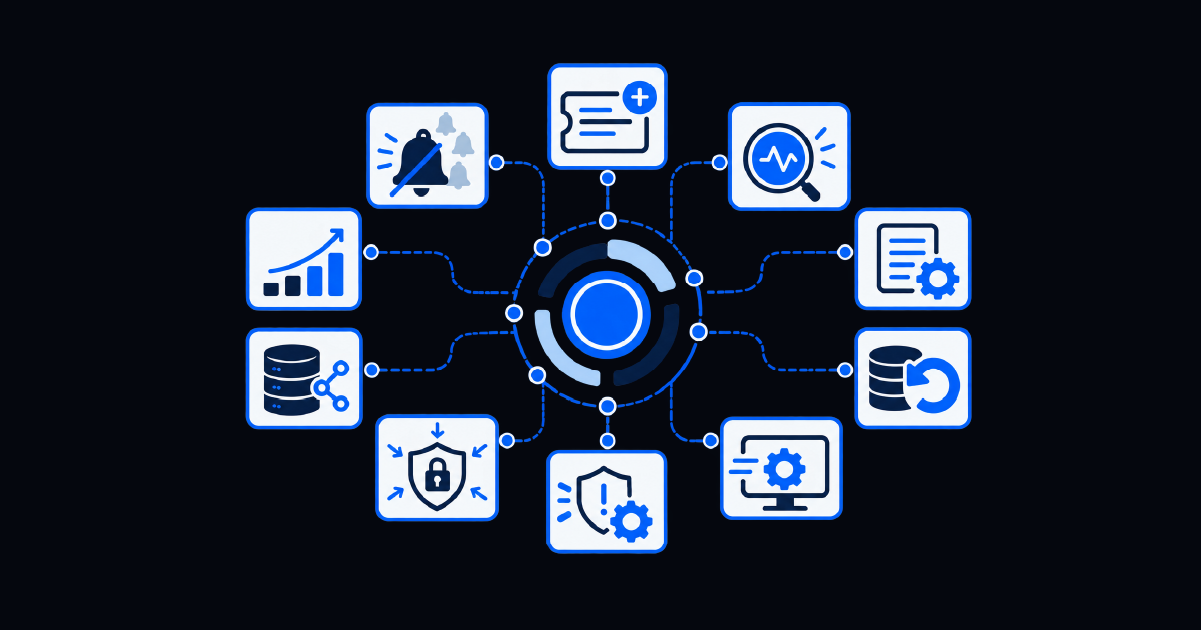
The Governance Controls Matrix
Why Agentic AI Governance Matters for Enterprise Automation
Intelligent automation and agentic AI belong together, but they are not the same thing. Traditional automation follows predefined steps. Agentic AI can interpret goals, gather context, choose the right workflow, and adapt as conditions change.
That flexibility is what makes agentic AI powerful. It is also what makes governance essential.
Without clear boundaries, trusted context, action controls, human oversight, and auditability, teams cannot confidently let AI agents operate across enterprise systems. With those controls in place, agentic AI becomes a practical extension of the team: able to resolve more work while keeping people focused on the decisions that require judgment.
Resolve helps teams move toward that model by combining AI-driven understanding with automation that works across IT environments. The goal is not just to answer requests faster. It is to resolve more work with the visibility, control, and oversight enterprise teams need.
If your organization is exploring agentic AI, the question is not whether governance will slow you down. The better question is whether your automation strategy can scale without it.
See how Resolve helps teams govern and automate AI-driven IT workflows. Request a demo →
FAQ: Agentic AI Governance
What is agentic AI governance?
Agentic AI governance is the framework that controls how AI agents access data, make decisions, take action, escalate issues, and document outcomes across enterprise systems.
Why does agentic AI need governance?
Agentic AI needs governance because AI agents can pursue goals, choose actions, and operate across systems with more autonomy than traditional scripted automation.
What controls are needed for agentic AI?
Core controls include permission limits, trusted data sources, human approval gates, action restrictions, rollback logic, observability, audit trails, and continuous policy review.
How is agentic AI governance different from traditional automation governance?
Traditional automation governance controls fixed workflows. Agentic AI governance controls decision-making, context use, autonomy levels, and dynamic actions.
What role should humans play in agentic AI governance?
Humans should review high-risk, ambiguous, sensitive, or irreversible actions while allowing agents to automate low-risk, well-defined tasks.