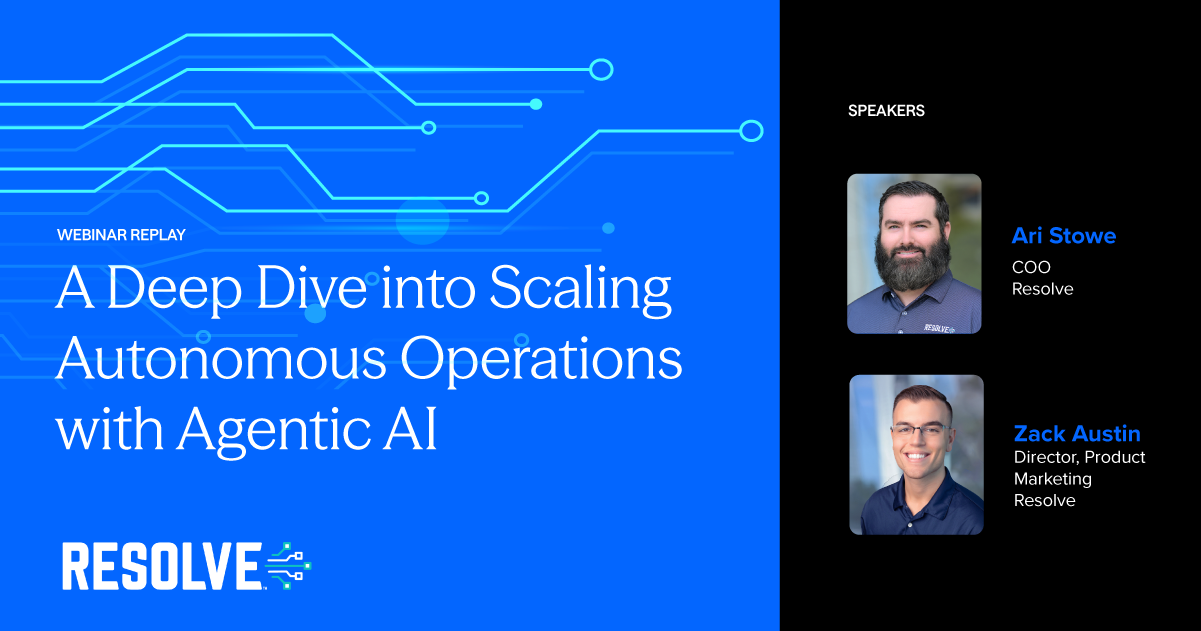
A Deep Dive into Scaling Autonomous Operations with Agentic AI


Overview
Enterprise IT teams are grappling with complex, cross-functional workflows that slow productivity and overwhelm the ticket queue.
Traditional ITSM automation models rely on scripts, intents, and manual orchestration that cannot keep pace with operational demands.
This webinar replay dives into how leading organizations are deploying agentic automation at scale, without scripts or intent models to deliver 2–5x faster resolutions and 70+% L1 deflection.
COO Ari Stowe and Director of Product Marketing Zack Austin cover:
- Why unifying enterprise chat, AIOps, and automation into a single resolution layer transforms operations
- A practical roadmap for adopting and scaling agentic automation in your organization
- A demonstration of Resolve's Agentic Resolution Fabric
Key Takeaways
- Agentic AI for IT operations is emerging as the next step beyond traditional ITSM automation. Instead of relying on brittle scripts and intent models, agentic automation can reason through context, decide what to do next, and execute workflows dynamically. This makes it far more scalable for enterprise IT automation teams dealing with high variability and constant operational change.
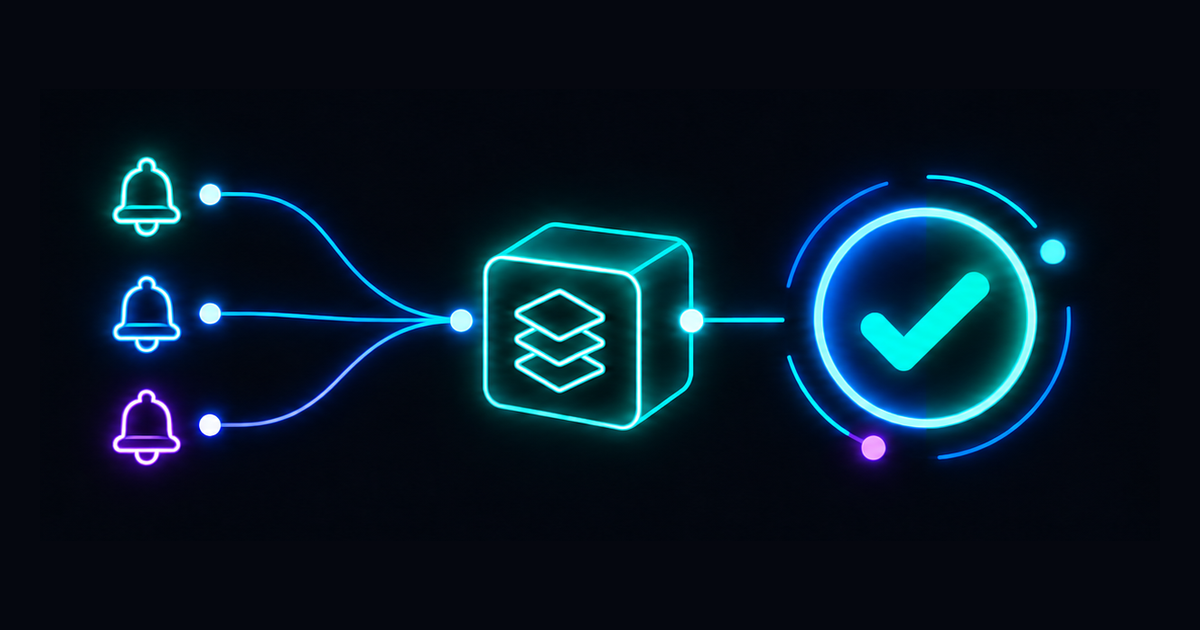
- A unified IT resolution layer is the key to scaling autonomous IT operations. Chat interfaces, an AIOps platform, and IT orchestration tools can’t operate as separate silos if teams want real outcomes. When these layers are unified into one resolution fabric, organizations can correlate signals, understand user intent, and execute IT process automation end-to-end.
- L1 ticket deflection is one of the fastest measurable wins from agentic automation enterprise adoption. By automating repetitive Tier 1 work and resolving issues at the point of need, organizations can reduce ticket volume dramatically while also improving response time.
- Scaling IT operations automation requires a roadmap, not a pile of disconnected automations. The discussion frames autonomous operations as a maturity journey: start with high-volume, low-risk use cases, build trust through controlled execution, then expand coverage into broader operational domains.
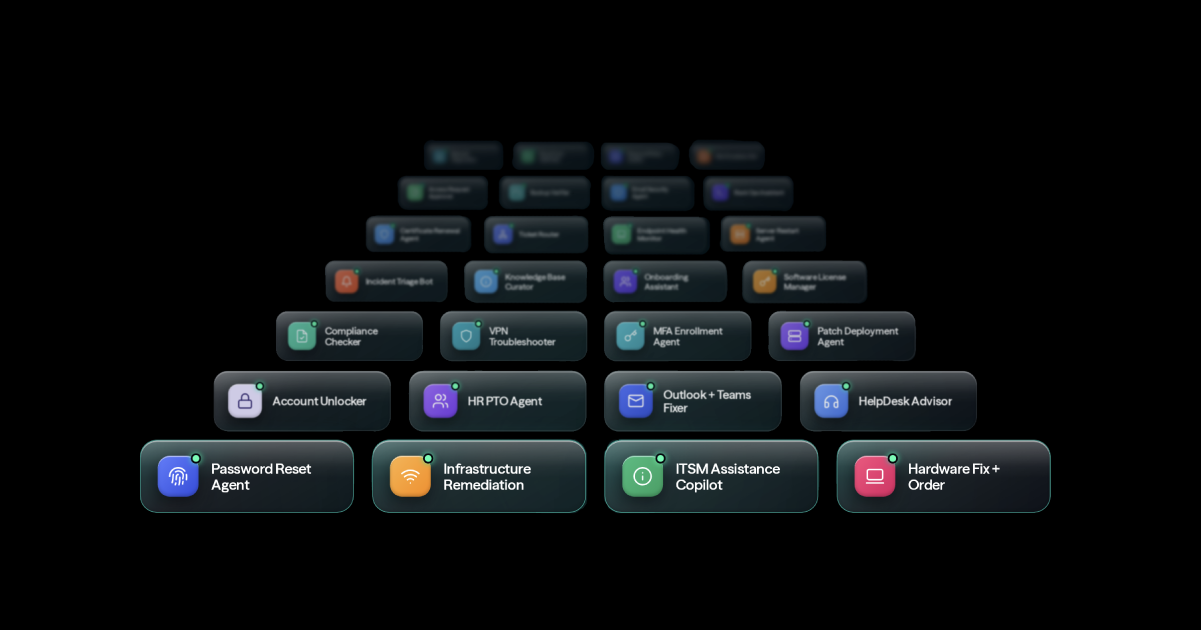
- The Agentic Resolution Fabric represents a shift from automation tooling to operational infrastructure. Rather than treating automation as a collection of workflows, Resolve positions agentic resolution fabric as the connective tissue across systems: pulling in context, applying policies, and coordinating execution.
FAQs
Q: AI assumes reliable context. How can we prevent AI from acting on flawed inputs?
A: Agentic AI for IT operations must be paired with guardrails, validation steps, and escalation triggers. Instead of allowing agents to blindly act on incomplete telemetry or inaccurate knowledge, teams should require context verification and define confidence thresholds. When the system detects uncertainty or conflicting signals, it should route to human review. This ensures autonomous IT operations remain safe while still enabling faster resolution at scale.
Timestamp: 45:45 - 48:49
Q: How can companies best build a database for IT problem causes and resolutions?
A: Building a reliable resolution database requires treating operational knowledge as structured infrastructure, not scattered documentation. Teams must capture consistent patterns: root causes, symptoms, actions taken, and outcomes. Over time, this creates a scalable foundation for IT process automation and IT orchestration, enabling agentic systems to recognize repeat incidents and execute resolution paths with higher accuracy.
Timestamp: 50:16 - 52:07
Q: Does Resolve host LLMs securely?
A: Enterprise-grade agentic automation requires secure deployment models, including strict controls around data handling and model access. Resolve’s approach supports enterprise requirements by ensuring LLM usage can be managed in a secure environment with governance and privacy protections, so organizations can scale IT automation without exposing sensitive operational data.
Timestamp: 51:51 - 53:06