ServiceNow Virtual Agent vs. Resolve: Which Is Better?
Conversational self-service inside ServiceNow versus agentic orchestration across the enterprise
The Short Answer
Choose Resolve when the priority is cross-system orchestration that can interpret a request, execute and verify work across the enterprise stack, and update ServiceNow without replacing it as the ITSM system of record. Resolve is built to reduce both ticket creation and the human work inside tickets that remain. Choose ServiceNow Virtual Agent with Now Assist (now branded as Otto) when the priority is native conversational self-service, knowledge, catalog, and workflow inside the Now Platform.
Enterprise IT teams need fewer tickets, faster resolution, and less manual work across identity, endpoint, cloud, network, collaboration, monitoring, and business applications.
That is why the search for ServiceNow Virtual Agent alternatives is changing. The old question was, “Which chatbot understands users best?” The new question is, “Which platform can understand the request, take the right action across systems, verify the result, and preserve governance?”
ServiceNow’s Now Assist (now branded as Otto) adds generative AI, LLM-based topic discovery, search, catalog ordering, and access to AI agents and agentic workflows. A fair evaluation should recognize those capabilities. It should also test whether the platform can deliver the autonomous resolution, cross-system orchestration, and pre-ticket outcomes your operating model requires.
Resolve approaches the problem from the opposite direction. Rather than treating the conversation as the product’s center of gravity, Resolve uses conversation as one signal into an agentic automation and orchestration layer for the service desk. The objective is Zero Ticket IT: answer what can be answered, automate what can be executed safely, and give technicians richer context only when human judgment is still required.
What Are ServiceNow Virtual Agent and Now Assist?
ServiceNow Virtual Agent is the conversational layer for self-service experiences in ServiceNow. It can guide users through Virtual Agent topics, surface knowledge, support catalog requests, and hand work to live agents or workflows. Now Assist brings large language models and generative AI into that experience.
In ServiceNow’s current documentation, Now Assist in Virtual Agent can use LLMs to discover user intent, synthesize responses, support multi-turn questions, surface Service Catalog actions, and route users to AI assets. ServiceNow also documents agentic conversations in which enabled AI agents can reason, plan, and execute multi-step flows.
That makes ServiceNow compelling when your service experience, records, catalog, knowledge, and controls already center on the Now Platform. The integration between conversation and ITSM context is native, and the platform can be expanded through ServiceNow workflows, spokes, tools, and AI agents.
What Is Resolve?
Resolve is an agentic automation and orchestration platform designed to resolve employee requests and operational issues across the enterprise technology stack. It belongs to the dedicated automation and orchestration platforms category, but its product model connects conversation, execution, technician assistance, and continuous learning rather than treating them as separate tools.
Resolve’s Agentic Resolution Fabric coordinates three purpose-built agents. Knowledge Agent interprets requests and grounds answers in enterprise context. Automation Agent runs diagnostics, approvals, remediations, verification, and cross-system workflows. Agent Assist enriches the exceptions that still need a technician and captures successful resolutions for future reuse.
For example, a request to restore application access might require identity verification, an Active Directory or Okta action, an endpoint check, a Microsoft 365 update, a ServiceNow record update, and confirmation in Teams or Slack. Resolve treats that chain as one governed outcome even though no single system owns every step.
Resolve is designed to coexist with ServiceNow. ServiceNow can continue to govern incidents, requests, changes, catalog, assets, and reporting while Resolve acts as the vendor-agnostic execution layer that connects knowledge, diagnostics, automation, approvals, verification, and communications. Replacing ServiceNow ITSM is a separate decision and is not required to use Resolve.
ServiceNow Virtual Agent Vs. Resolve: The Key Differences
The Deciding Factor Is Autonomous Resolution
A good answer can prevent an unnecessary escalation. But many IT requests cannot be solved with information alone. The platform must change a system, coordinate dependencies, and confirm that the change worked.
Autonomous resolution means the platform can complete a governed sequence with minimal human intervention: understand intent, collect context, run diagnostics, choose or trigger an approved workflow, execute actions, verify the outcome, update the system of record, and communicate the result. For higher-risk changes, autonomy should include approval gates rather than bypass them.
This is where buyers should look beyond a conversational AI demo. Ask the vendor to resolve a real, multi-system issue in a production-like environment. Watch what happens when a step fails, data is missing, permissions are insufficient, or a verification check returns an unexpected result.
Cross-system Orchestration Determines the Ceiling
Enterprise workflow automation is only as useful as its reach. If the platform can find an answer but cannot act across the systems that control identity, devices, software, infrastructure, and communications, the service desk still inherits the work.
ServiceNow can orchestrate beyond its own records through integrations and configured tools. Dedicated automation platforms make cross-domain execution their core product surface. Resolve, for example, can trigger from tickets, chat, alerts, email, and schedules, orchestrate across systems, and run alongside ServiceNow and other ITSM platforms. Resolve also offers 500+ native integrations and 5,000+ workflow templates.
How Pricing and Packaging Differ
Pricing is a meaningful difference, and buyers should compare total contract economics.
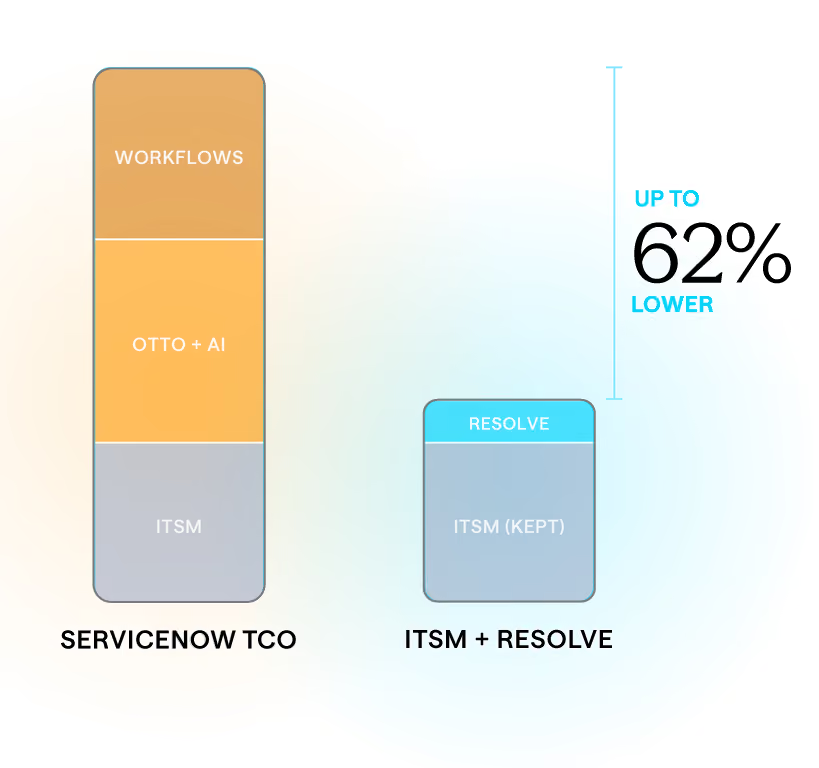
ServiceNow packages AI capabilities across Foundation, Advanced, and Prime tiers, with final pricing, entitlements, and usage allowances dependent on the customer agreement.
Resolve offers flat pricing and no per-ticket, per-user, per-workflow, or token fees, which may make costs more predictable as automation volume grows.
Compare both options using the same ticket volume, automation executions, integrations, implementation services, retained ServiceNow licenses, and expected consumption.
What Resolve Looks Like Alongside ServiceNow
Consider an employee who cannot access a finance application. Resolve can:
- Receive the request in Teams, Slack, a portal, or another channel
- Use enterprise context to identify the user and application
- Check entitlements and device state
- Invoke identity and endpoint actions
- Request approval when policy requires it
- Verify access
- Notify the employee
- Write the outcome back to ServiceNow.
- If the issue cannot be resolved autonomously, Agent Assist can enrich the ServiceNow ticket before a technician opens it.
This architecture gives IT leaders a practical middle path. They can keep the ServiceNow investment that already supports service processes and governance while using Resolve to extend autonomous execution across systems that ServiceNow does not own.
Ticket Deflection Is Useful, But Resolution Is The Stronger Metric
Ticket deflection can mean different things. One tool may count a conversation that never reached a live agent. Another may count an automatically resolved ticket. A third may count an issue resolved before a ticket was created. Those outcomes are not equivalent.
Define the numerator and denominator before comparing vendors. Then separate at least four measures:
- Knowledge resolution: the user received a sufficient answer and confirmed success.
- Transaction completion: the requested catalog item or standard service action completed successfully.
- Autonomous remediation: diagnostics, action, and verification completed without agent work.
- Pre-ticket resolution: the issue was resolved before an incident or request entered the service queue.
Resolve highlights customer outcomes ranging from 58% to 90% ticket deflection across several named deployments.
When Resolve Is The Better Choice
Resolve is the stronger choice when these conditions dominate:
- Requests routinely cross multiple systems and teams before they can be verified as complete.
- Your environment includes several ITSM, identity, endpoint, cloud, network, monitoring, or collaboration platforms.
- The business case depends on reducing manual execution and preventing tickets, not only improving chat containment.
- You need event-driven remediation, scheduled operations, or infrastructure automation in addition to employee self-service.
- You want the execution layer to remain portable if the system of record changes.
- You need reusable automation that can serve IT, HR, facilities, finance, or other operational functions.
Choosing Resolve does not automatically mean replacing ServiceNow. For many enterprises, the practical architecture is using ServiceNow as the system of record, with Resolve handling orchestration and autonomous execution across the rest of the stack.
When ServiceNow Virtual Agent Is The Better Choice
Virtual Agent with Now Assist is likely the stronger fit when most of the following are true:
- Your first priority is improving ServiceNow self-service, search, catalog completion, and agent handoff.
- Your internal team has the skills, licensing, governance, and capacity to build and maintain the required integrations and workflows.
- Consolidating administration and controls on the Now Platform matters more than introducing an orchestration layer.
Where Resolve Differs from Now Assist
Resolve differs from ServiceNow Virtual Agent and Now Assist by moving the center of value from interaction to outcome. Its differentiation is the combination of enterprise knowledge, cross-system execution, and technician assistance in one feedback loop, rather than a conversational layer that depends on separate automation to finish the work.
- Keep ServiceNow, change the economics of resolution. Resolve is designed to run above ServiceNow ITSM, so teams can preserve the system of record while reducing reliance on additional ServiceNow automation and AI layers.
- Start with repeatable work, then expand. Password resets, account unlocks, access provisioning, software fulfillment, incident diagnostics, alert remediation, and network operations create a measurable path from service desk deflection to broader enterprise automation.
- Build for both human and machine demand. The same orchestration layer can respond to an employee request, a ServiceNow record, an observability alert, or a scheduled job, which helps unify service automation and operations automation.
- Make governance part of execution. Resolve offers approval gates, RBAC, audit trails, agent testing, and policy boundaries as native controls. Buyers should verify those controls against their change, security, and compliance requirements.
- Measure prevented work, not only handled work. Resolve’s Zero Ticket IT message prioritizes verified pre-ticket resolution, autonomous remediation, hours returned, and lower escalation demand alongside conventional deflection metrics.
Frequently Asked Questions
What is the best ServiceNow Virtual Agent alternative?
There is no universal best alternative. Resolve belongs on the shortlist when the requirement is autonomous, multi-system resolution rather than a conversational experience alone. Test both against the same high-volume, high-effort workflows.
Is Now Assist a conversational AI platform or an automation platform?
Now Assist is ServiceNow’s generative AI layer. In Virtual Agent, it improves conversational discovery, answers, catalog experiences, and access to skills, AI agents, and agentic workflows. Its automation depth depends on the workflows, tools, integrations, licensing, and governance configured around it.
Can Resolve work with ServiceNow?
Yes. Resolve runs alongside ServiceNow. ServiceNow can remain the ITSM system of record while Resolve interprets requests and signals, executes cross-system workflows, verifies outcomes, and updates ServiceNow.
What makes Resolve different from Now Assist?
Now Assist is native generative AI for ServiceNow workflows and experiences. Resolve is a vendor-agnostic agentic automation and orchestration layer. Its Knowledge Agent, Automation Agent, and Agent Assist are designed to move work from answer to autonomous action to technician-supported exception handling across the wider enterprise stack.
Does Resolve replace ServiceNow?
Resolve can replace selected ServiceNow self-service, AI, and automation capabilities without replacing ServiceNow ITSM. A common model keeps ServiceNow for records and service governance while Resolve becomes the cross-system execution layer.
What should a proof of concept include?
Use three to five production-representative workflows: one knowledge-led request, one standard transaction, one multi-system remediation, one exception path, and one approval-controlled change. Measure completion, verification, handoffs, build effort, maintenance effort, and user experience.