
Why Standard Service Desk Automation Doesn’t Reduce Ticket Volume (and What Does)

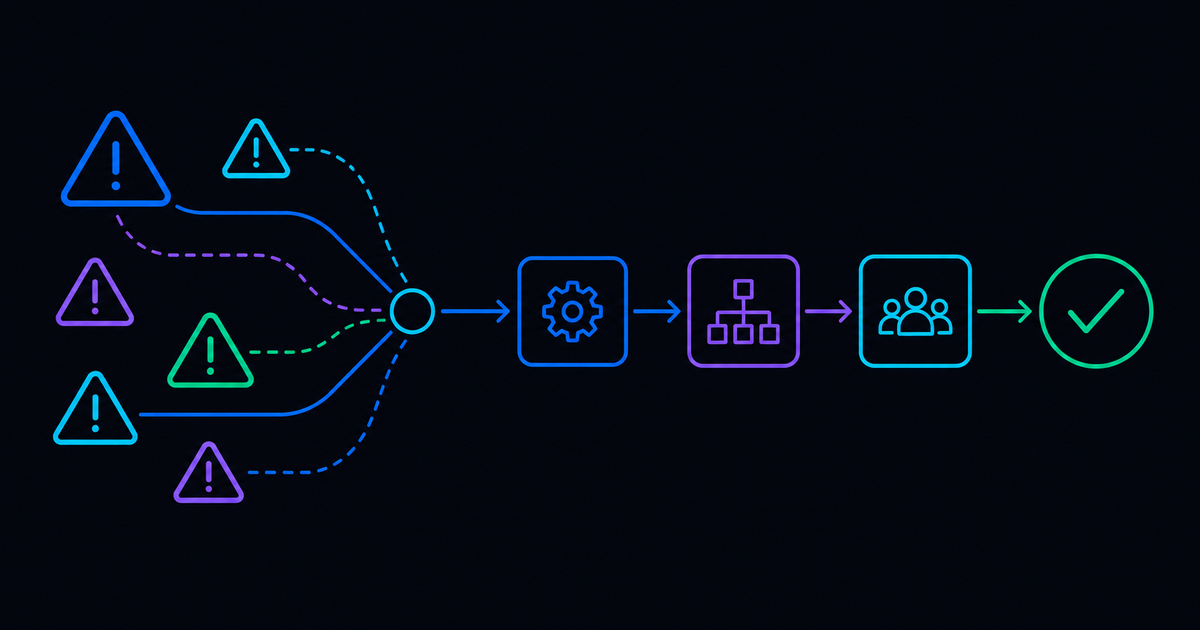


The platform has been live for six months. Workflows are running, the virtual agent is fielding requests, and the vendor dashboard shows deflection numbers are going up. Then someone pulls the actual ticket volume report, and it looks almost identical to the one before the rollout.
This comes up constantly in enterprise IT, and most teams respond the same way. They tell themselves the platform needs more automations, a wider user base, and another quarter to mature. Months pass. The number still has not move
Standard service desk automation wasn’t designed to reduce ticket volume at the scale most organizations project. The problem usually starts before the contract is signed. Teams buy the platform expecting ticket volume to drop, but the product was never built to stop most tickets from forming in the first place.
These are the five assumptions that keep ticket volume from moving.
Myth 1: "If Automation Is Running, Tickets Should Be Dropping"
On paper, this makes sense. Automation replaces manual work. Manual work generates tickets; therefore, automation should reduce volume. What that misses is where most automation tools enter the process.
Most service desk automation platforms are built to process work that has already entered the queue. A ticket gets created, enters the queue, and the platform takes over from there, routing it or triggering a scripted response. The ticket itself never stopped forming. Volume never had a reason to drop.
Deflection, the way most platforms define it, means the ticket was handled without a human agent picking it up. A ticket resolved by automation is faster and cheaper than one that sat in a queue for two hours. The ticket still existed, though. It still entered the system. The ticket volume didn’t change.
Measuring ticket volume when the automation only touches work already in the queue is the wrong test entirely. The metric worth watching is how many issues were resolved before a ticket was ever created. You won’t see that number in most standard-deflection dashboards, which is part of why it can take so long to catch the problem.
What To Track Instead
Look at how many issues were caught and resolved before a ticket was created. Most standard dashboards won’t share this number cleanly, so you might need to pull it from your monitoring or incident data separately. If your platform has no visibility into pre-ticket resolution at all, then that’s worth flagging before you have your next vendor conversation.
Myth 2: “Our Deflection Rate is Climbing, So It’s Working”
Deflection rate gets the most attention in service desk automation, and it’s also the metric that gets misread most often. When the number goes up, it feels like confirmation that the platform is doing its job. The problem is that deflection rate has a built-in ceiling, and most teams won’t see it until they’ve already hit it.
Standard automation platforms perform well within a narrow range: high-volume, predictable requests where the resolution path is already documented. Password resets and basic access requests are the kind of work where intent is consistent, and the resolution is already written down. These use cases make early deflection numbers look strong and are also the first ones to get captured, but once that range is automated, the deflection rate stabilizes. By then, the platform has picked off the easy work. What remains is the messier work that doesn’t follow a simple script.
The requests that sit outside of that range, incidents that need judgment or span multiple systems, keep landing on engineers regardless. Deflection climbs to 25 or 30 percent, then stops. The team keeps waiting for the next phase that never arrives.
What To Track Instead
Pull the deflection rate specifically on requests that fall outside your top ten use cases. That number tells you more about the platform’s ceiling than the overall deflection rate does. If it’s close to zero, the platform is handling the work it’s always going to handle, and everything else is still going to a person. A rising overall deflection rate with a flat rate on complex requests is a sign that the platform has stopped expanding.
Myth 3: “The Problem is Adoption”
When ticket volume won’t budge, adoption is the first thing that companies blame. Employees must still be submitting tickets the old way, or the service catalog needs more work. Adoption is a real factor in any platform rollout, but it’s also one of the most convenient explanations for problems.
Here’s a test worth running: Look at the tickets that entered the automation workflow and still landed on an engineer. Those users did exactly what they were supposed to do by going through the platform, but the workflow still handed the ticket off.
If a significant share of tickets that entered the automation path still required a human to finish them, then the adoption story stops making sense. Adoption is a pre-platform problem.
What To Track Instead
Track the completion rate for tickets that entered the automation path, meaning how many were fully closed by the platform without a human stepping in. If that number is low, adoption is not the variable worth fixing. Look at where in the workflow the handoff to an engineer is happening the most. That’s usually where the platform runs into a system it can’t reach or an approval it can’t complete. When you find this spot, you can bring a specific problem to the vendor.
Myth 4: We Just Need Better Categorization and Routing
Most teams pour time into routing because the logic is sound: tickets that reach the right place faster should resolve faster, and faster resolution should mean lower volume. Better classification does deliver on part of that. Misrouted tickets drop, resolution speed improves slightly, and the queue looks more organized, but the volume report doesn’t move.
Routing and resolution are two separate things. A ticket that gets classified correctly and dropped into the right queue in 30 seconds is still a ticket. A human still has to pick it up and work through the resolution. Better routing optimizes that path, but it doesn’t reduce the number of paths that need to be walked.
Teams spend quarters tightening classification models and refining routing rules, and the ticket volume report shows almost none of it. The work has value. Routing does not address where the volume originates. A well-organized queue and a smaller queue are different outcomes.
What To Track Instead
Find out how many tickets the platform actually closed versus how many it just moved faster. Those are two different outcomes and most reporting treats them the same way. A team can cut routing time by 40 percent and still have engineers carrying the exact same workload. If the queue is moving quicker but the same number of people are still closing tickets, the efficiency gains are showing up in the wrong column.
Myth 5: The Platform Just Needs More Time to Mature
Maturity is a reasonable expectation for any enterprise software development. Complex integrations take time to stabilize, and building automation coverage across a large environment is also a gradual process.
There is a version of the maturity argument that gets used to delay a harder conversation. This tends to happen in month four or five when the metrics are still not moving in the way they were meant to be moving, based on the projections.
What are you actually getting better at, though? More use cases, sure. That's straightforward. But the idea that a platform gets smarter just by existing? That's harder to swallow. Platforms have hard limits baked into their architecture, and age doesn't change that. A rule-based tool doesn't magically develop judgment. A virtual agent stuck at 30% deflection isn't going to drift up to 70% next year just because you waited.
What To Track Instead
Ask the vendor what the highest deflection rate is that their platform can realistically reach for your ticket mix, not the average they publish across all their clients. Then ask what it would actually take to push that number higher. If the answer involves custom development or upgrading to a more expensive tier, that's important to know before you're sitting across from them at renewal.
What Actually Moves the Needle
Your automation platform sits downstream of the problem. By the time a ticket reaches it, someone has already had to stop what they were doing and file one. Layering more automations onto that setup doesn't change anything upstream because nothing in the architecture was built to stop issues from reaching the queue in the first place.
What changes the volume is catching problems before they become tickets at all. A server starts degrading at 2 AM, and something detects it, fixes it, and your engineers never wake up. In order for this work, you need connections across your entire environment, not just your ticketing tool, and most platforms weren't built that way.
Then there's what happens when tickets do come in. The reason that so many workflows still end with a human is the platform hits a system it can't touch and gives up. Actual resolution without the handoff means reaching every system involved in closing the issue, which is a much harder bar to clear than routing it faster.
The messiest part of the remaining queue is everything that doesn't match a known pattern. Standard platforms are built around a library of scenarios that someone designed in advance, and anything outside that gets bounced. Getting that work handled means being able to operate in situations the system has never seen before, and that's a different kind of capability than most teams are buying when they sign a service desk contract.
How Resolve Works Differently
Resolve keeps working where traditional automation stops. RITA understands intent, pulls context from your environment, and executes workflows across ITSM, identity, endpoint, and infrastructure systems.
Teams using Resolve have reduced ticket volume by over 70 percent in just six months, improved MTTR by up to 70 percent, and increased first-contact resolution above 60 percent. Guardant Health achieved 70 percent ticket deflection with RITA while giving employees 24/7 self-service support through Slack and Jira integrations.
If ticket volume has not changed in years, the issue may not be staffing. It may be an operating model designed to manage tickets instead of eliminate them.

.png)
.png)