Why Your ITSM is NOT Your Orchestration Platform

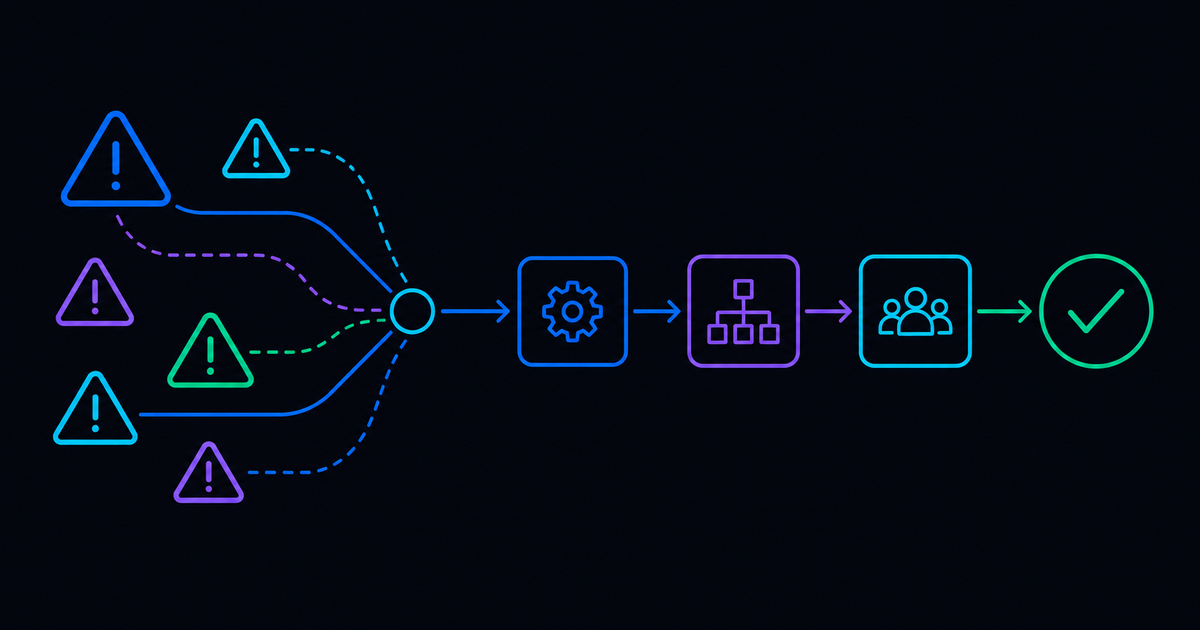

Overview
Requests, incidents, and service workflows should move at machine speed, but most organizations still rely on their ITSM platform as the orchestration nerve center. Tickets, approvals, and fragmented workflows slow resolution and limit how far orchestration can scale.
IT leaders know more orchestration is needed, but ITSM-native tools were designed for workflow management, not cross-domain work. Teams are left trying to automate complex operational tasks inside a ticketing system, limiting coverage.
If this sounds familiar, we’ve got you covered. In this webinar, we’ll explore why ITSM platforms aren’t built to be cross-domain orchestration tools and how a modern approach that combines intelligent orchestration with agentic AI changes what’s possible. We’ll show how organizations can move beyond ticket-driven workflows to orchestrate real-time actions across your digital ecosystem.
In this webinar replay, Resolve’s Principal Sales Engineer, Derek Pascarella, and Director of Product Marketing Zack Austin for a breakdown of:
- Why ITSM workflow orchestration alone cannot support modern IT operations
- How combining intelligent orchestration with agentic AI enables autonomous resolution
- What moving beyond ticket-driven automation and orchestration looks like across incidents, service requests, and operational workflows
See how leading IT teams are transforming service operations with intelligent orchestration and agentic AI.
Key Takeaways
- ITSM platforms solve a real coordination problem, but they were built for human-paced workflow management, not real-time orchestration across domains. They work well as systems of record for SLA tracking; however, when used as the automation engine for modern operations, their limitations show up as everything from slower responses to more fragile workarounds.
- Much of what’s called “automation” inside ITSM only accelerates the administrative layer, not the work itself. Faster routing and assignment may improve dashboards, but they don’t reduce mean time to resolution unless diagnostics and remediation are also automated. That’s the difference between automating paperwork and automating operations.
- Marketplace-bound automation creates a limit on scale. If an integration isn’t available, teams often write custom scripts or, worse yet, leave the use case untouched. As a result, automation opportunities pile up or rely on tribal knowledge, making it difficult to scale without adding headcount.
- A modern orchestration layer should sit outside the ITSM. The ITSM remains valuable for tickets and governance, while orchestration handles cross-domain execution. Tickets become outputs when needed instead of the starting point; this enables real-time responses instead of sequential handoffs.
- AI delivers the most value when applied selectively at decision points instead of across entire workflows. Deterministic automation handles known remediation paths, while AI supports classification, pattern recognition, and approvals. This balance preserves predictability and governance while enabling more expedient and autonomous resolution.
FAQs
Q: Why doesn’t faster ITSM automation necessarily improve resolution times?
A: Because most ITSM automation speeds up ticket handling instead of the work itself! Faster routing and assignment may improve response metrics, but resolution only improves when diagnostics and remediation are automated. Otherwise, you’re just moving tickets faster, not issue resolution.
Timestamp: 14:18–15:21
Q: Do organizations need to replace their ITSM to adopt an orchestration layer like Resolve?
A: Nope! Resolve is designed to complement your ITSM, not replace it. Existing workflows can run until they reach their limit, then pass control to Resolve for last-mile automation. Teams can expand orchestration over time without a disruptive rip-and-replace approach, culminating in meaningfully improved experiences for all.
Timestamp: 45:27–47:00
Q: How does Resolve use generative AI in operational workflows without introducing risk?
A: Resolve leverages AI for decision-making, like classifying issues, selecting workflows, and identifying when approvals are needed. However, execution is handled by deterministic, pre-built workflows to ensure top-of-the-line governance. Guardrails and approval points keep teams in control while empowering automation to still act.
Timestamp: 55:16–58:38
.png)
.png)