Incident Management KPIs: The Metrics Your IT Ops Team Should Track



At a Glance
- MTTD, MTTA, MTTR, FCR, and SLA compliance provide a practical core set of incident management KPIs for most IT operations and ITSM teams.
- Each KPI measures a different stage or outcome of the incident lifecycle, so relying on MTTR (or any single metric, for that matter) can hide important bottlenecks elsewhere in the process.
- Supporting measures such as incident volume, escalation rate, and reopen rate provide additional context, while NOC and automation teams can layer specialized metrics onto this foundation.
- Consistent measurement creates the baseline teams need to prove whether changes to processes, tooling, or automation are actually improving incident performance.
Incidents are inevitable. Spending three meetings arguing over whether your incident management process is actually improving is slightly more avoidable. Either way, avoiding adverse conditions begins with one element: consistent measurement.
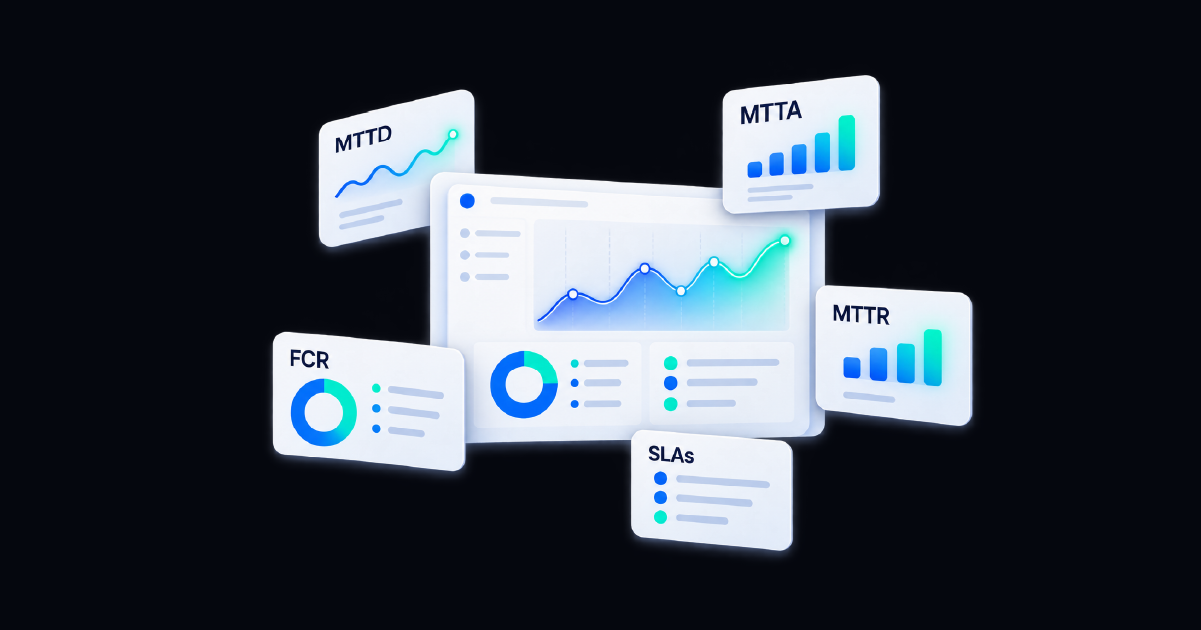
For most teams, a handful of incident management KPIs provide a reliable picture of performance from the moment something goes wrong through to final resolution. Mean time to detect (MTTD), mean time to acknowledge (MTTA), mean time to resolve (MTTR), first contact resolution (FCR), and SLA compliance each measure a different stage of that lifecycle.
Taken together, they can tell you where delays occur, how effectively teams resolve issues, and whether service commitments are being met.
These aren't the only incident management metrics worth tracking. NOC teams, service desks, and automation programs may need additional measures specific to their goals. But these five provide a strong baseline for understanding incident performance... As well as for proving whether future process and automation improvements are actually working.
Why Incident Management KPIs Matter
You can't improve what you don't measure. More importantly, you can't reliably prove improvement if everyone measures it differently.
A consistent KPI baseline gives IT teams a way to identify bottlenecks and compare performance over time. If MTTA suddenly rises while MTTD remains stable, for example, the problem probably isn't detection. Something may be slowing down alert routing or responder engagement.
The same baseline becomes essential when evaluating automation. Before you can say automation reduced MTTR or improved SLA performance, you need to know where those numbers started.
For a deeper look at establishing KPIs for an automation program, see our KPI Compass for IT Automation.
Mean Time to Detect (MTTD)
What it tracks: The average time between an incident occurring and the organization detecting it.
Why it matters: An incident nobody knows about isn't getting fixed.
MTTD measures how quickly your monitoring and observability practices identify problems. A high MTTD can indicate monitoring gaps, poorly configured alerts, or incidents that aren't becoming visible until users start complaining.
How to measure it:
MTTD = Total time from incident occurrence to detection ÷ Number of incidents
The difficult part is establishing when the incident actually began. When that timestamp isn't available, teams may use the first observable symptom instead. Whatever definition you choose, apply it consistently.
Reducing MTTD gives responders an earlier start—and limits the amount of time an incident can quietly cause damage before anyone begins investigating.
Mean Time to Acknowledge (MTTA)
What it tracks: The average time between detecting an incident and a responder acknowledging it.
Why it matters: Detection isn't particularly useful if the alert spends the next 20 minutes waiting for somebody to notice it.
MTTA helps reveal operational problems between monitoring and response. A long MTTA can indicate ineffective routing, alert fatigue, unclear ownership, or problems with on-call processes.
How to measure it:
MTTA = Total time from detection to acknowledgment ÷ Number of incidents
Use the initial alert or detection timestamp and compare it with the first recorded human acknowledgment in your alerting or ticketing system.
If MTTA is consistently high, resist the temptation to immediately blame responders. Hundreds of noisy or low-value alerts can make fast acknowledgment nearly impossible. The process surrounding the responder may be the real problem.
Mean Time to Resolve (MTTR)
What it tracks: The average amount of time required to fully resolve an incident.
Why it matters: MTTR is one of the most widely used incident management KPIs because it connects operational performance directly to service disruption.
The longer critical systems remain unavailable or degraded, the greater the potential impact on employees, customers, revenue, and productivity.
How to measure it:
MTTR = Total resolution time ÷ Number of resolved incidents
There's an important catch: organizations don't always agree when the clock starts.
Some measure MTTR from detection to resolution, but others begin at acknowledgment. Either approach can work, but your team should explicitly document which definition it uses. Otherwise, comparing MTTR across teams (or even across different reporting tools) can quickly become an apples-to-oranges exercise.
MTTR should also be considered alongside the other metrics here. A falling MTTR looks impressive until you discover incidents are being closed prematurely and reopened later.
First Contact Resolution (FCR)
What it tracks: The percentage of incidents resolved by the first responder or team without escalation.
Why it matters: Every handoff introduces another opportunity for delay.
Strong FCR suggests that frontline teams have the knowledge, access, and capabilities necessary to handle a meaningful portion of incoming incidents themselves. Low FCR can reveal knowledge gaps, restrictive permissions, poor routing, or processes that unnecessarily depend on specialized teams.
How to measure it:
FCR = Incidents resolved at first contact ÷ Total incidents × 100
Don't treat 100% FCR as the goal. Complex incidents should reach specialists when necessary. Instead, use FCR to understand whether issues that should be resolved at the first level actually are.
SLA Compliance
What it tracks: The percentage of incidents that meet applicable service-level commitments for response or resolution.
Why it matters: Most incident management metrics describe internal operational performance. SLA compliance connects that performance directly to expectations set with the business or customers.
Missing those commitments can damage user trust and, depending on the agreement, carry financial or contractual consequences.
How to measure it:
SLA compliance = Incidents meeting SLA requirements ÷ Incidents subject to the SLA × 100
Remember that not every incident has the same threshold. A critical outage may require a dramatically faster response than a low-priority issue. Measure performance against the SLA applicable to each incident rather than treating every ticket identically.
Related Measures Worth Tracking Alongside These
The five KPIs above cover the core incident lifecycle, but they don't always tell the whole story. A few supporting measures can provide important context, especially when a headline KPI appears to improve or decline unexpectedly.
Specialized Variants for Specific Teams
Not every operations team should use exactly the same scorecard.
A NOC, for example, may place greater emphasis on availability, event volume, network performance, and infrastructure-specific measures. Our guide to five key network operations metrics explores that perspective in more detail.
Automation programs need another layer as well. Measures such as automation coverage, proactive resolution rate, and mean time to automated resolution (MTTAR) can show how effectively automation itself is performing. See our guide to IT automation KPIs that matter for that specialized metric set.
These measures should supplement the fundamental incident management KPIs above, not replace them.
Building a KPI-Driven Culture, Not Just a Dashboard
A beautifully designed dashboard nobody uses is just... expensive wallpaper.
KPIs create value when teams regularly review them, investigate changes, and use them to improve processes. They shouldn't exist solely for monthly reporting to leadership or as another way to pressure individual agents.
That distinction matters. Used well, metrics can expose systemic problems and help teams remove friction from frontline work. Our service desk automation playbook explores the relationship between KPIs, automation, and agent morale in more depth.
How Resolve Helps Teams Track and Improve These KPIs
Once you've established a baseline, the next question is how to improve it.
Resolve helps IT teams automate and orchestrate work across the incident lifecycle, connecting operational signals with the actions required to investigate and resolve issues.
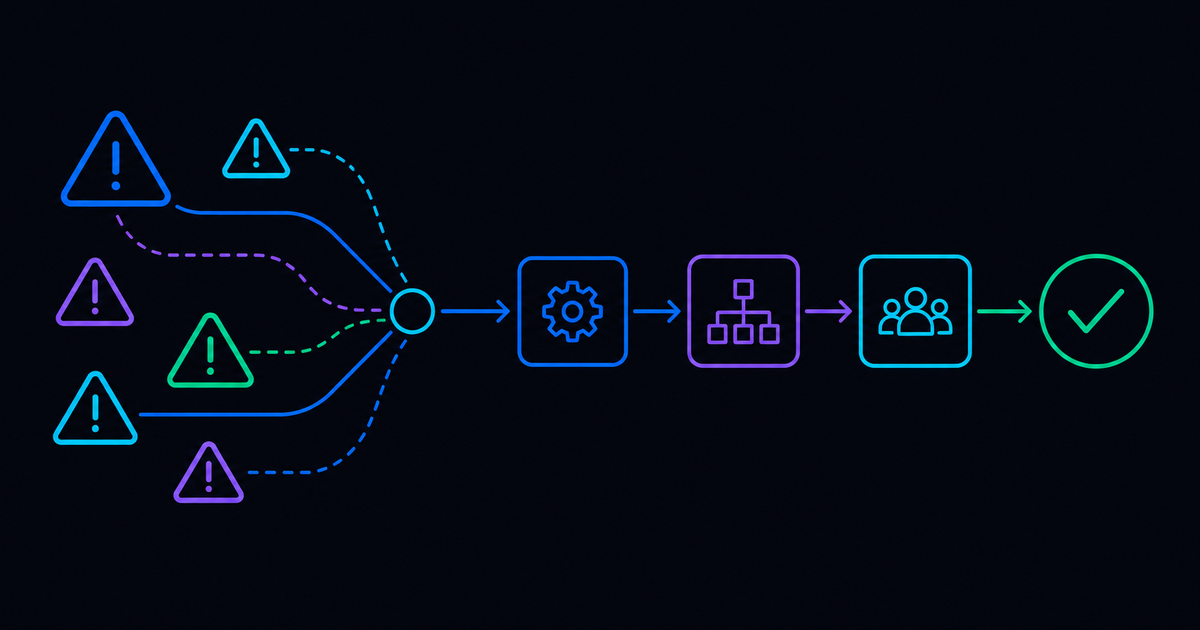
That can mean triggering workflows as soon as monitoring detects a known condition, automatically gathering diagnostic information, enriching tickets with additional context, executing remediation steps, or escalating an issue when human expertise is required.
The goal is to connect automation to the incident management KPIs that already matter: faster resolution, fewer unnecessary escalations, stronger SLA performance, and less manual effort spent on repeatable incidents.
That connection is what turns automation from a collection of task counts into something IT teams can measure against the baseline they've already established.
Measure What Matters, Then Improve It
Incident management doesn't require dozens of KPIs to produce useful insight.
For most IT operations and ITSM teams, MTTD, MTTA, MTTR, FCR, and SLA compliance provide a strong foundation. Together, they show how quickly incidents are discovered, how quickly teams respond, how efficiently they resolve them, and whether they're delivering against service commitments.
Incident volume, escalation rate, and reopen rate add context, while specialized teams can layer NOC- or automation-specific measures on top.
The important part is consistency. Establish the definitions, document the baseline, and measure the same way over time. Once you know where performance stands today, you have something concrete to improve tomorrow.
Resolve ties automation directly to the metrics that matter for your incident management program.
Frequently Asked Questions
What Are the Most Important Incident Management KPIs?
For most IT operations and ITSM teams, the core incident management KPIs are mean time to detect (MTTD), mean time to acknowledge (MTTA), mean time to resolve (MTTR), first contact resolution (FCR), and SLA compliance. Together, they measure how quickly incidents are identified, acted upon, resolved, and handled within agreed service levels.
What Is the Difference Between MTTD, MTTA, and MTTR?
MTTD measures the time between an incident occurring and being detected. MTTA measures the time between detection and a responder acknowledging the incident. MTTR measures how long it takes to fully resolve the incident, although organizations should specify whether their MTTR clock begins at detection or acknowledgment.
How Do You Measure Incident Management Performance?
Start with consistent definitions and timestamps across your incident management systems. Track core metrics such as MTTD, MTTA, MTTR, FCR, and SLA compliance over a defined period, then use supporting measures such as incident volume, escalation rate, and reopen rate to provide context. Comparing those metrics against an established baseline reveals whether performance is improving over time.
How Can Automation Improve Incident Management KPIs?
Automation can reduce delays throughout the incident lifecycle by detecting known conditions, gathering diagnostics, enriching tickets, executing approved remediation, validating recovery, and escalating exceptions. The impact should be measured against established incident KPIs rather than automation activity alone—for example, whether automation actually reduced MTTR, improved SLA compliance, or lowered escalation rates.