Major Incident Management: A Playbook for I&O Teams

At a Glance
- A major incident is a service disruption with severe business impact that requires an accelerated, cross-team response beyond standard incident handling.
- Effective major incident management defines declaration criteria, command roles, communication intervals, resolution validation, and closure requirements before an outage occurs.
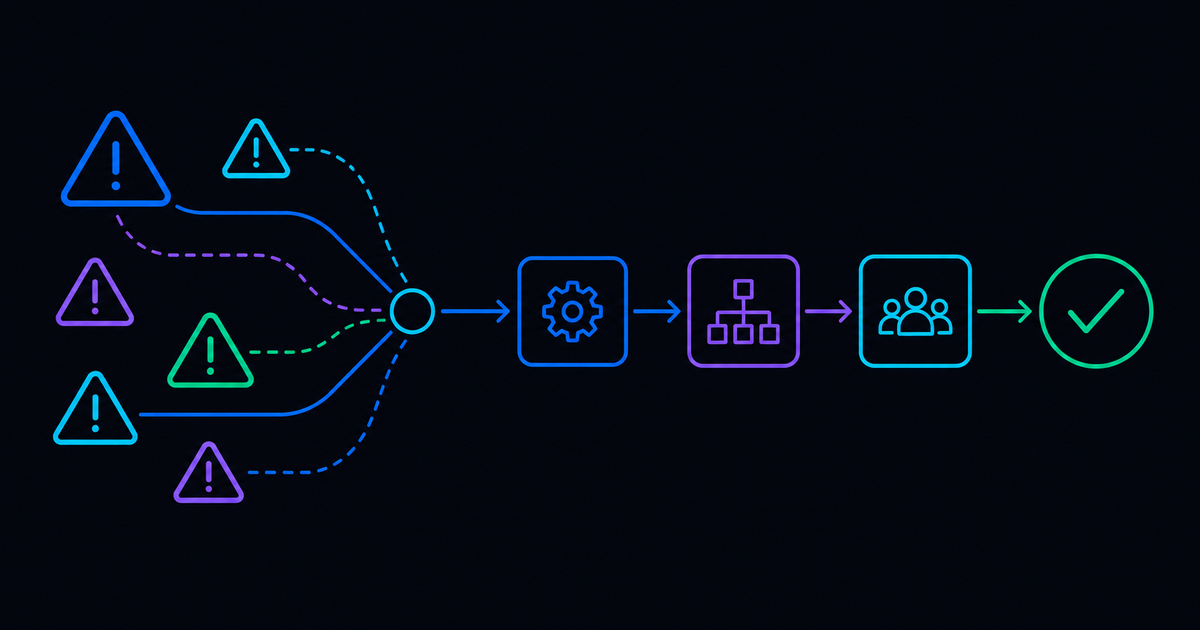
- Automation can shorten the path from detection to verified recovery by correlating alerts, launching runbooks, gathering diagnostics, and updating stakeholders.
- Enterprise incident management depends on consistent processes and reusable runbooks across teams and services, not improvised heroics.
- Blameless post-incident reviews turn response evidence into better runbooks, stronger automation, and more resilient services.
It's 2 a.m. Monitoring alerts are firing, the on-call engineer is being paged, and customer reports are arriving faster than anyone can triage them. A bridge call opens. Infrastructure, network, application, and service desk teams hop on with different fragments of context. Meanwhile, executives want to know the scope, customer impact, and expected recovery time.
This is not the moment to decide who is in command or how often updates should go out. I&O teams need a playbook that converts those critical first minutes into a coordinated response.
What Qualifies as a Major Incident?
A major incident is an unplanned service disruption with substantial business impact that demands an urgent, coordinated response outside the normal incident workflow. The label should reflect impact and risk rather than technical complexity alone: a simple failure affecting a critical customer service can be more serious than a complicated fault with limited reach.
Declaration criteria commonly consider three factors:
- Business impact: A critical business capability is unavailable, revenue or operations are materially affected, or employee productivity is disrupted at scale.
- Customer-facing scope: Many customers, a strategically important account, or a public digital service is affected.
- SLA breach risk: Current or projected downtime threatens a contractual commitment, regulatory obligation, or recovery objective.
Each organization should convert those factors into documented service thresholds. The criteria must let an authorized responder declare a major incident without waiting for perfect information.
Standard incident management often moves work through a queue toward a resolver group. Major incident management runs investigation, containment, remediation, business assessment, and communication in parallel. An incident commander coordinates those streams while technical leads restore service, and a communications owner maintains a predictable cadence. These are essential incident management best practices when the cost of delay is high.
The Major Incident Management Lifecycle
A reliable lifecycle gives responders a shared operating model from the first alert through formal closure. Teams can adapt the details to their environment, but each stage needs a clear owner, required action, and exit criterion.
The incident commander should manage the process, not become the primary troubleshooter. Technical leads own their workstreams, while a scribe records timestamps, evidence, actions, decisions, and results.
Communication should follow a defined interval even without a major technical change. Each update should cover impact, current knowledge, active work, available workarounds, and the next update time.
Resolution requires more than seeing a dashboard turn green. Validate the affected business service, confirm queued work is recovering, and monitor for regression before standing down.
Where Automation Fits in Major Incident Response
Automation should remove predictable work while preserving human control over consequential decisions. It gives commanders and technical teams faster, more reliable execution.
Reduce Time to Declare
Monitoring and AIOps tools can correlate related alerts, suppress duplicates, and enrich signals with service and dependency context. That evidence helps responders distinguish an isolated fault from a widespread disruption sooner. Automation observability connects detection with governed action.
Trigger Runbooks for Known Failure Patterns
When a correlated alert matches an approved pattern, automation can collect diagnostics, test dependencies, restart a service, roll back a change, or apply a workaround. Approval gates can remain for higher-risk actions, and the workflow should verify the result in the incident record.
Keep Stakeholders Informed
Automated workflows can populate incident channels, ticket fields, stakeholder notifications, and status tools from the same validated event data. Templates improve speed and consistency, while the communications lead retains control over interpretation, customer language, and recovery estimates.
Eliminate Repetitive Response Steps
Paging teams, opening collaboration channels, gathering logs, checking system health, updating records, and scheduling the review are necessary but repeatable. Automating them reduces omission risk and lets specialists focus on diagnosis, containment, and recovery. Resolve's AIOps automation approach illustrates how correlated alerts can trigger diagnosis, remediation, verification, and closure workflows across operational systems.
Building Consistency for Enterprise Incident Management
Enterprise incident management spans regions, business units, vendors, clouds, networks, and application teams. It cannot depend on one engineer remembering the last outage.
Standardize the Operating Model
Define one minimum command structure, severity model, communication standard, evidence requirement, and closure process for the enterprise. Services can add specialized diagnostic and recovery steps, but local variation should not change who can declare an incident, where the official record lives, or how accountability works.
Build Reusable, Governed Runbooks
Runbooks should specify triggers, prerequisites, permissions, actions, decision points, validation checks, rollback paths, and escalation conditions. Store them where teams can find and maintain them, and test them after platform changes. A modern runbook automation strategy turns stable procedures into repeatable workflows without hiding their controls or outcomes.
READ MORE: What Are the Best Runbook Automation Tools?
Use Central Command Without Creating Another Silo
Teams need a shared operational view of severity, affected services, roles, workstreams, decisions, and communications. That command layer should integrate with monitoring, AIOps, ITSM, collaboration, and status tools rather than forcing responders to abandon the systems they already use. The ITSM platform should remain the authoritative incident record while orchestration coordinates action across domains.
Post-Incident Review Best Practices
A post-incident review should explain how the system and response behaved, not identify someone to blame. Hold it while evidence remains fresh and responders can assemble an accurate timeline.
Review detection, declaration, escalation, diagnosis, communication, remediation, validation, and closure. Identify where teams waited, repeated work, lacked access, used outdated instructions, or acted without reliable context.
Convert findings into owned, time-bound actions for runbooks, alert logic, service maps, communication templates, training, and the remediation library. Test the changes against detection, declaration, engagement, restoration, and recurrence measures. A postmortem creates value only when its lessons change the next response.
How Resolve Supports Major Incident Response
Resolve adds governed automation and orchestration to the monitoring, AIOps, ITSM, infrastructure, network, cloud, and collaboration tools I&O teams already use. Correlated signals can launch workflows that gather context, query live systems, execute approved remediation, validate service health, update the incident record, and escalate exceptions to the right responders.
This approach helps compress the interval between detection and verified recovery without removing necessary controls. Human approval can govern high-impact actions, every automated step can be recorded, and reusable workflows help teams execute the same response across services and regions. Resolve's I&O automation platform is designed to connect observability response with cross-domain remediation at enterprise scale.
Win the First Minutes of a Major Incident
Major incidents will always contain uncertainty, but the response does not have to be improvised. Clear declaration thresholds, dedicated command, parallel workstreams, disciplined communication, verified recovery, and blameless review give I&O teams a dependable way to act under pressure.
Automation strengthens that playbook by performing known work at machine speed and returning evidence to the people making decisions. Teams that standardize and automate major incident management can reduce avoidable delay, improve MTTR, and turn each disruption into a more resilient operating model.
Frequently Asked Questions
What is major incident management?
Major incident management is the accelerated process used to coordinate roles, technical workstreams, communications, recovery, and review during a service disruption with severe business impact.
Who should declare a major incident?
Organizations should authorize defined roles, such as the service desk lead, duty manager, or incident commander, to declare a major incident when documented impact, scope, or SLA-risk thresholds are met.
What does an incident commander do?
The incident commander owns response coordination, assigns roles, sets priorities, manages escalation and communication, and confirms closure while technical leads investigate and restore service.
Which major incident response steps should be automated first?
Start with repeatable, low-risk work such as alert enrichment, paging, channel creation, evidence collection, health checks, stakeholder templates, ticket updates, and tested remediation runbooks for known failure patterns.
.png)
.png)